
By Mogau Makitla
The 7th Pan Africa ILGA Regional Conference is underway in Johannesburg, South Africa – bringing together LGBTQI+ activists, advocates, and community leaders from across the continent and beyond!
Under the rallying call “Unbreakable: Our Pride, Our Power, Our Future” participants are convening to reflect, strategise, and strengthen collective action in the face of mounting challenges. The pre-conference sessions set a powerful tone, grounding participants in remembrance, solidarity, and a renewed commitment towards building a more inclusive and liberated future.
A central part of the gathering is the intentional act of holding space for members of the LGBTQI+ community who have passed- whether through violence, discrimination, illness, or systemic neglect. This remembrance serves not only as a moment of mourning but also as a reminder of the urgency of the work ahead.
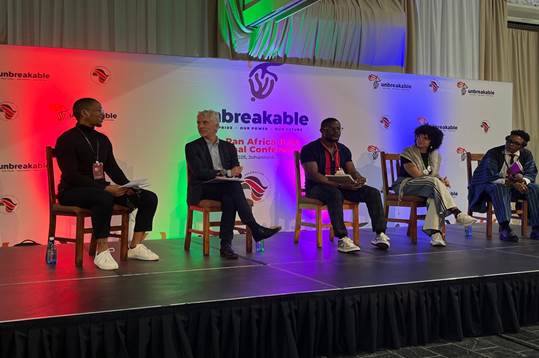
Panellists in a discussion titled Confronting the Backlash, Defending Rights in Hostile Times.
Many discussions have been centred on how to collectively resist the rise of anti-gender and anti-rights rhetorics across the globe. Participants discussed strategies for countering misinformation, strengthening grassroots mobilisation, and building alliances across the region and globe. A recurring theme was the need to change public narratives– to transform hearts and minds- in order to foster more accepting and inclusive societies. As Graeme Reid, the UN Independent Expert on Sexual Orientation and Gender Identity, reminded participants, “We need to persuade a wide range of people that our struggle is their struggle.” In this, collaboration is not simply beneficial – it is essential. Activists explored how confronting such backlash requires unified strategies that are innovative, grounded in knowledge sharing, and strengthened through cross-movement partnerships that reinforce shared values.
The importance of working from an intersectional lens has been continuously highlighted, to ensure we understand the interconnected nature of struggles across identities, experiences, and contexts. Each community and each individual also faces unique obstacles shaped by nationality, race, gender identity, class, disability, and other social positions. Recognising these key points will guide us in building responses that are holistic, inclusive, and equitable
Speakers also highlighted the importance of grounding advocacy in country-specific contexts. While similar trends affect many African nations, each country has its own political dynamics, cultural landscapes, and legal frameworks. Effective organising requires both continental solidarity and deep local understanding.
Another key question was how movements can hold space for healing justice- exploring wellness and collective care, even while confronting hostility and limited resources. Attendees reaffirmed that care work, rest, mental health support, community healing- is not a luxury but a vital part of sustaining our activism. Our movement cannot be unbreakable if its people are worn down or unsupported.
With global financial priorities shifting away from LGBTQI communities, the question of sustainability has become urgent. Participants explored new models of resilience, community-driven initiatives, resource sharing, local philanthropy, and innovative partnerships to ensure that movements can continue building power even as traditional funding streams decline.
As the 7th Pan Africa ILGA Regional Conference continues, the conversations reflect both the fragility and strength of the movement- its grief and its resilience, its challenges and its unwavering determination. If the message of the gathering is clear, it is this: We are unbreakable. Our pride grounds us. Our power sustains us. Our future is ours to shape – together!